
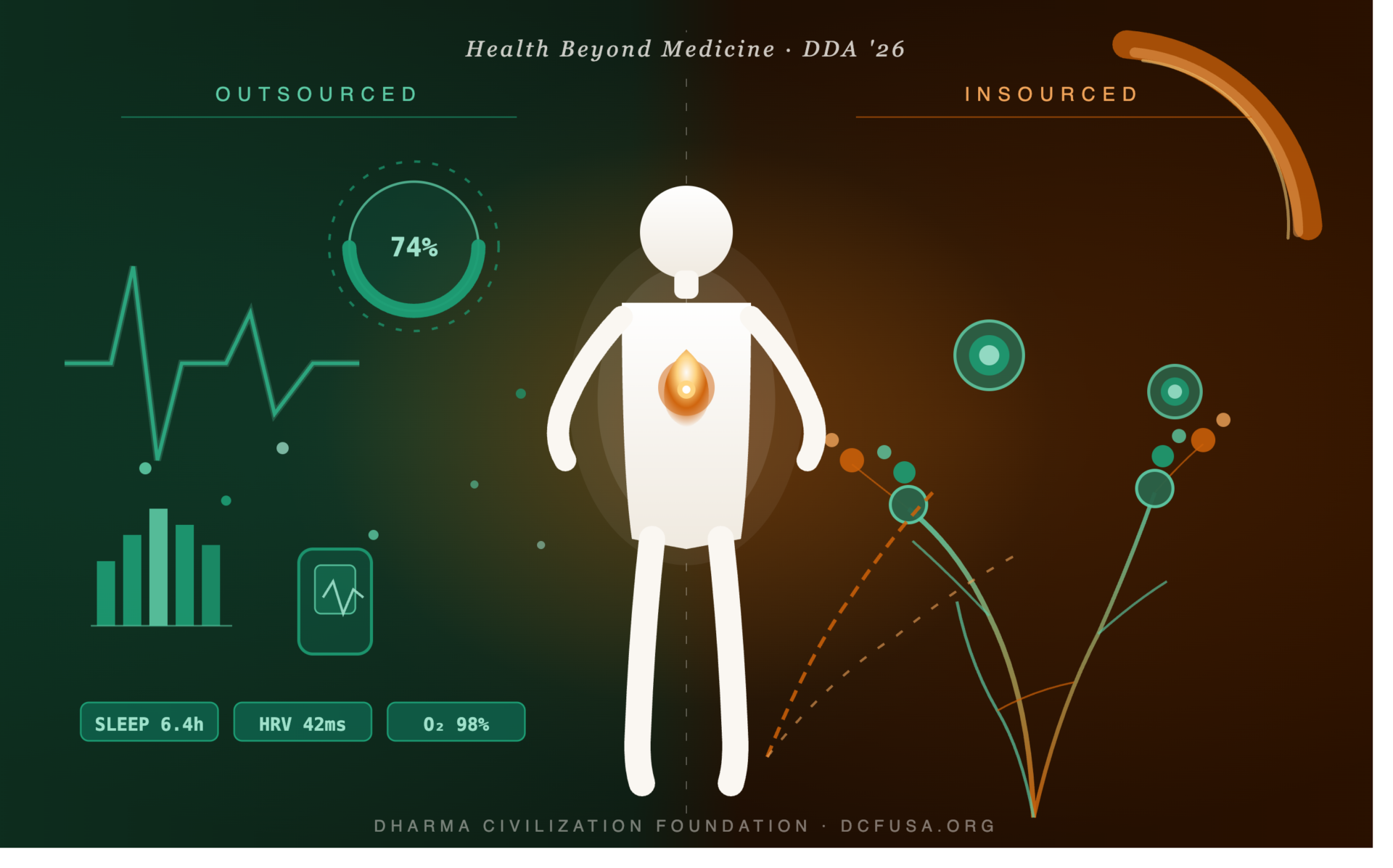
Modern culture has taught us to outsource our sense of well-being — to wearables, sleep trackers, lab panels, and algorithmic coaching. At DDA '26, the Health Beyond Medicine panel challenged this directly: health is our natural state. Our bodies possess an innate inner intelligence. By simplifying our approach and reconnecting with that intelligence, managing health can become a state of harmony rather than a source of ongoing stress.
This was the defining argument across two and a half hours of conversation in the Hilton University of Houston Ballroom — and it ran deeper than lifestyle tips. It was a philosophical reorientation, rooted in Dharmic wisdom and backed by contemporary public health research.
"True health is multidimensional social flourishing — not just the absence of disease."
The question we put to attendees — before and during the session
"What is the biggest barrier to your personal well-being in the current 'always-on' culture?"
Themes that came back repeatedly: the impossibility of switching off, guilt around rest, confusion between optimisation and health, and the erosion of undistracted time with family. The panel addressed each of these directly.
Who Was in the Room
The Panelists
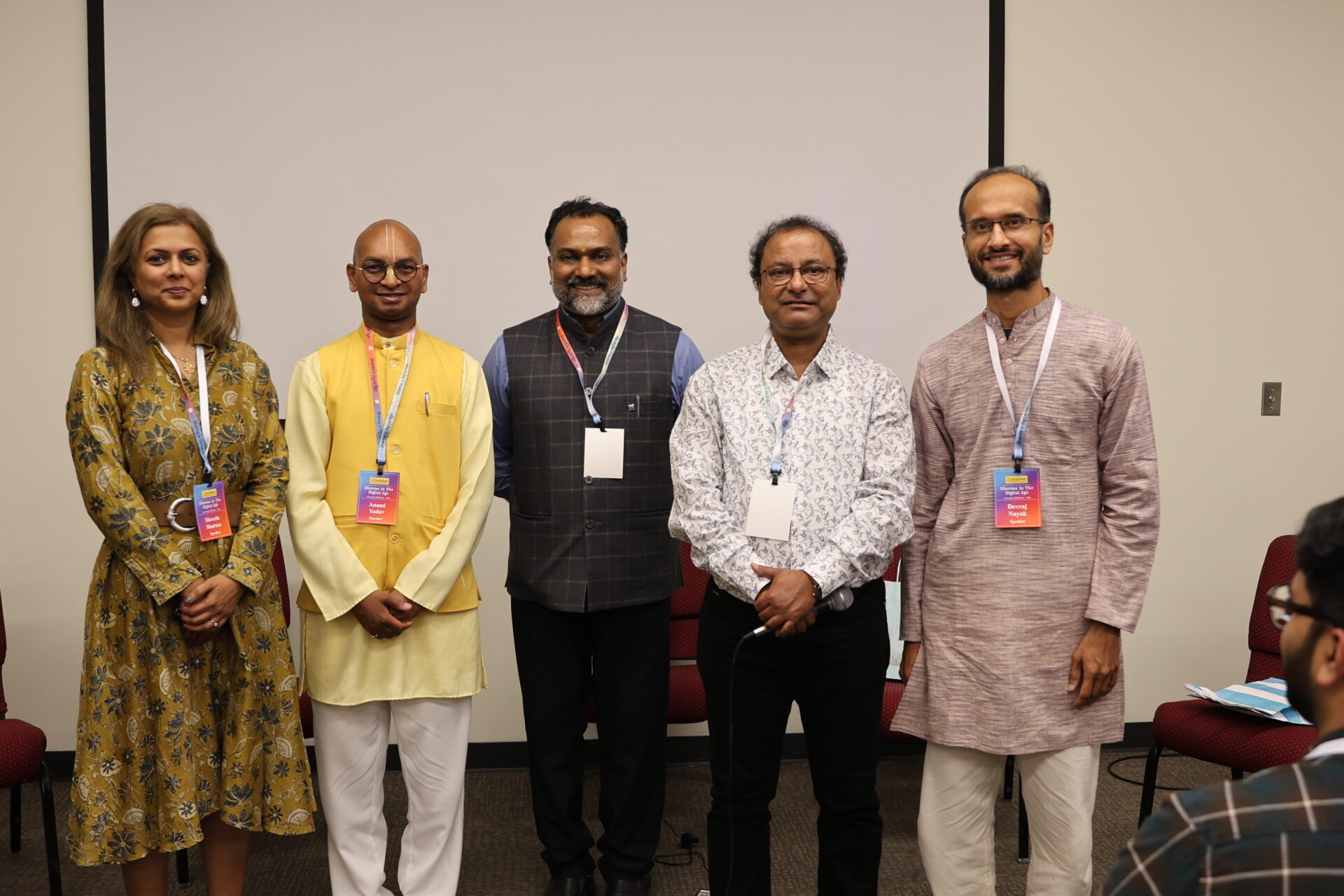
Founder, Hemlata Ayurveda Ancient Healing, Houston. Practitioner of classical Ayurvedic medicine.
Cardiologist and striving spiritual aspirant exploring the frontier between cardiac care and inner wellbeing.
Globally recognised Health Economist and Prevention Scientist; expert in health systems and policy advocacy.
Epidemiologist and public health researcher at UTHealth Houston.
Health and wellness expert facilitating conversations at the intersection of modern medicine and traditional healing.
What the Experts Taught Us
Four Pillars of Reclaimed Health
These are not lifestyle hacks. They are four domains where we have progressively handed our inner authority to external systems — and four invitations to take it back.
Sleep & Circadian Rhythms
The Practice
Align with the natural circadian window. The deep-sleep period between 10 PM and 2 AM is physiologically irreplaceable — no quantity of morning hours compensates for it.
The Shift
Judge sleep quality by lived, organic outcomes — morning freshness, concentration, healthy elimination, enthusiasm — rather than exclusively by wearable data streams. The tracker follows you; it doesn't define you.
Food & Sensory Consciousness
The Practice
Reclaim a diet built on real, whole, mostly plant-based foods. Ultra-processed products are engineered for addiction — not nourishment — and the panel was unambiguous about this distinction.
The Shift
Practise mindful eating: eliminate screens at the table, bring full visual attention to food, engage traditional sensory awareness to support optimal digestion. This is not ritual — it is biology.
Daily Routine & Inner Alignment
The Practice
Classical Ayurveda offers precise vocabulary for what modern life gets wrong. Prajnaparadha (willful error against inner wisdom) and Asatmya-indriyartha-samyoga (unwholesome misuse of the senses) are not archaic — they describe the smartphone at midnight.
The Shift
Disease often manifests when we repeatedly act against our internal intelligence. Shift physical movement away from exhaustion and performance toward disciplined moderation — classical guidance suggests concluding exercise at roughly half-capacity.
Information & Attention Hygiene
The Practice
Audit your digital consumption actively. The panel drew attention to subtle architectures — corporate, institutional, and algorithmic — that shape which scientific narratives reach us and which stay marginal.
The Shift
Behavioural disorders, rising anxiety, and social fragmentation are directly intensified by convenience culture and sensory overload. Protecting attention from uncritical device reliance is not a productivity hack — it is a health intervention.
Closing Reflection
What Stayed With the Room
What the Health Beyond Medicine panel ultimately offered was not a wellness protocol — it was a reorientation. The conference's broader thesis — that the Dharmic tradition carries knowledge forms the digital age has not yet asked — found its clearest expression here. Ancient medicine did not fragment the body from the mind, the individual from their rhythms, or the person from their community. Modern healthcare has performed all three separations, and the data show the cost.
The four pillars above are not a checklist. They are an invitation to notice where, in daily life, you have handed your inner authority to an external system — and to consider taking it back, one practice at a time.
"The question is not whether technology can improve health. The question is who is in charge — you, or the dashboard."
The conversation is far from over. We hope this recap gives it a second life in your homes, clinics, classrooms, and WhatsApp groups.
Watch the Full Session
The complete panel recording is now available. Two and a half hours of unfiltered conversation between five experts who rarely share a stage.
Watch Now →